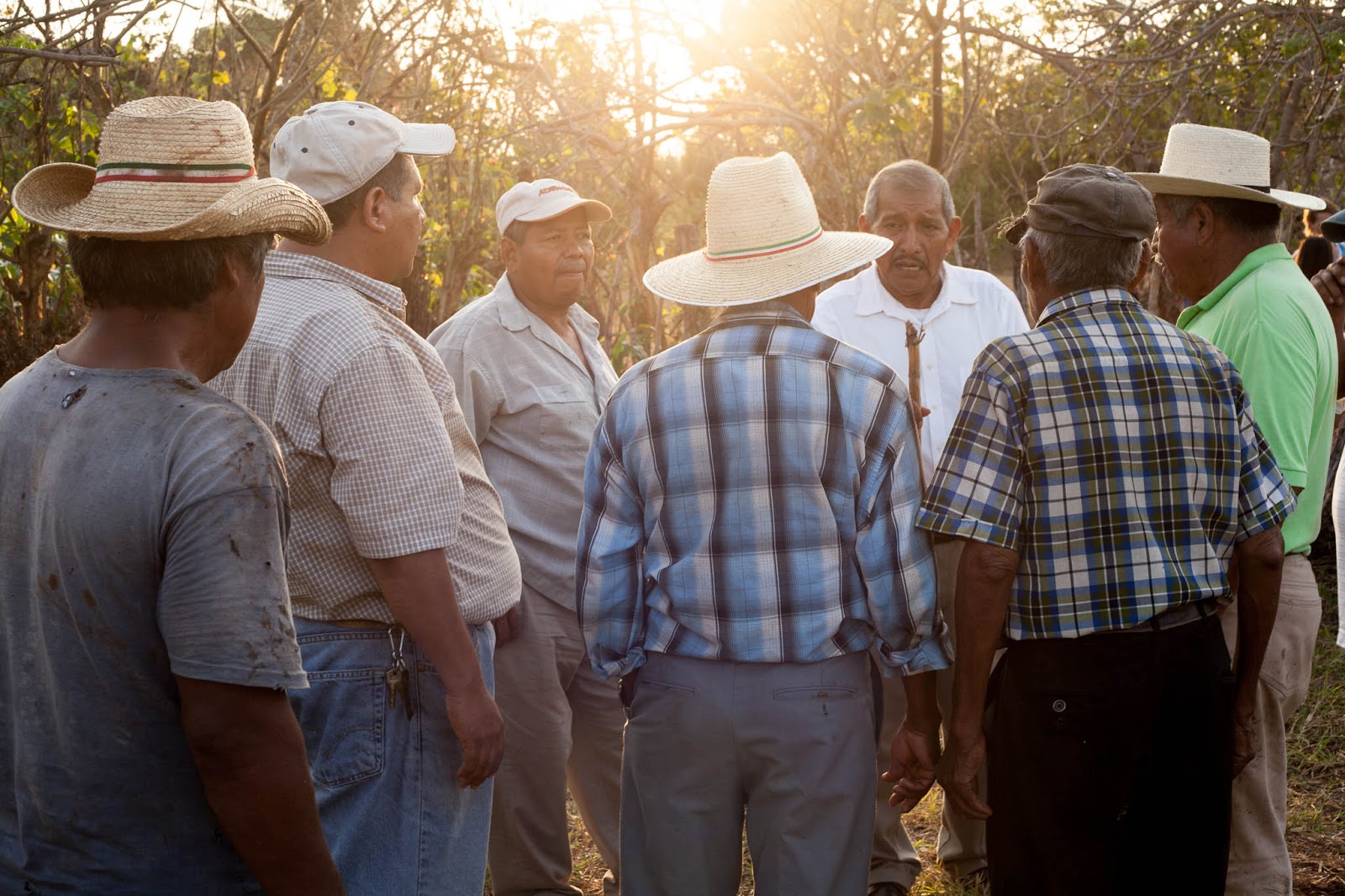
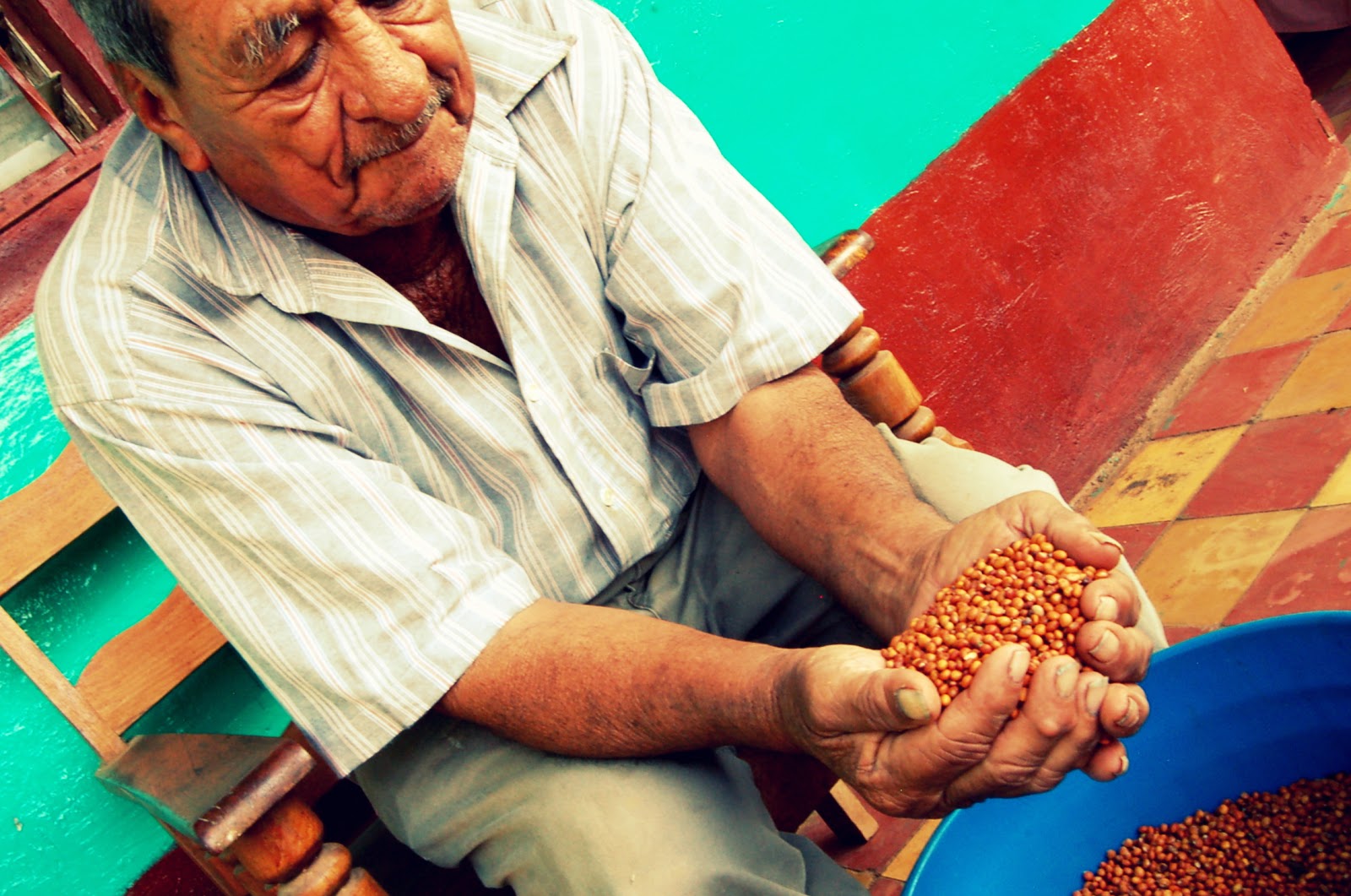
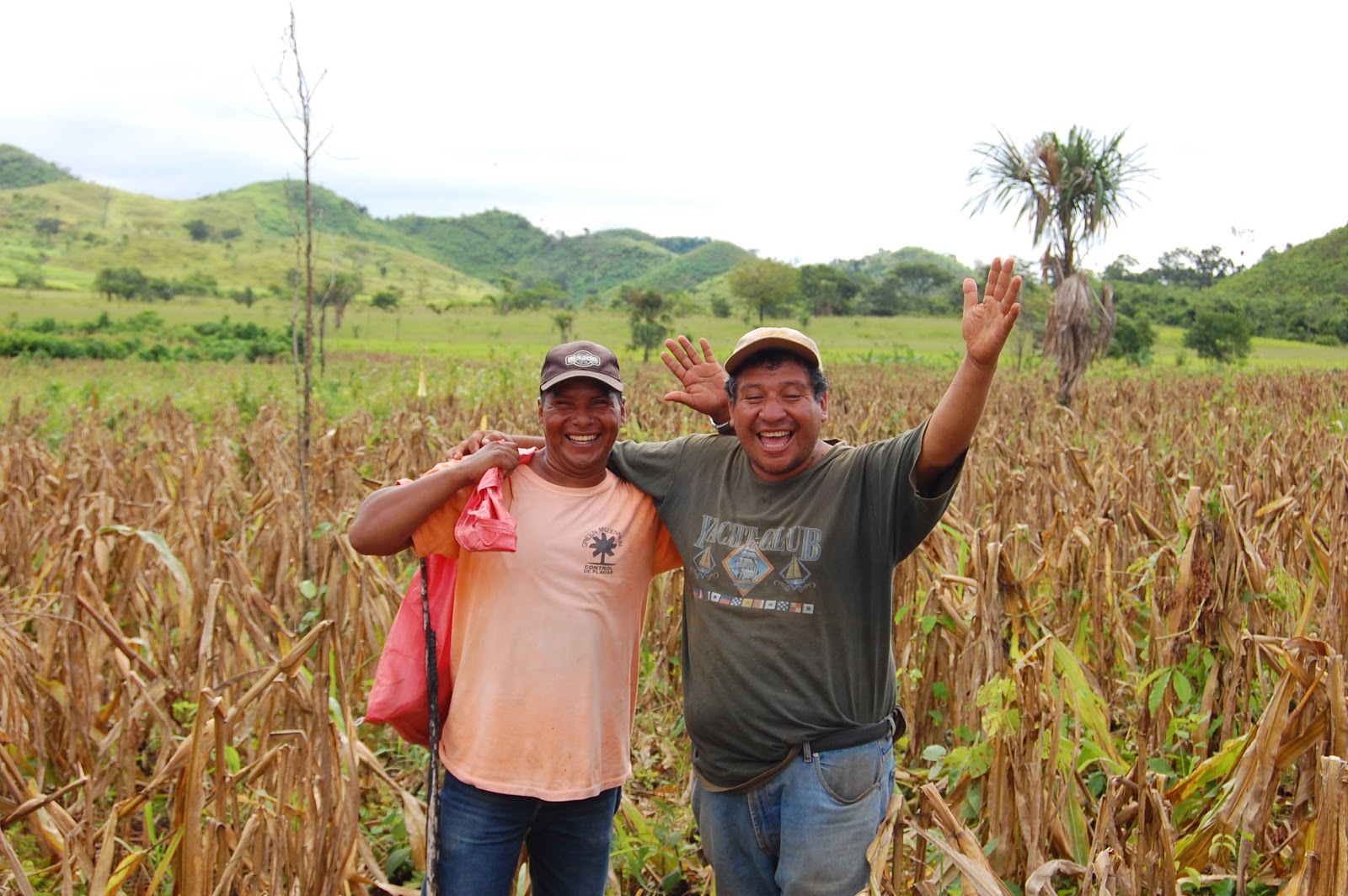
As the rains begin to fall this May in Guatemala, Semilla Nueva is working with farmers to try out a different type of corn, Quality Protein Maize (QPM). By simply experimenting with this alternative variety of high-protien corn (the crop grown everywhere that provides up to 60% of their diet), farmers can transform the face of malnutrition in their communities. Scientists from the International Maize and Wheat Improvement Center (CIMMYT) were awarded the World Food Prize in 2000 for their development of QPM, a variety that held all of the necessary amino acids to make corn a complete protein, with 90% of the protein of milk. QPM has been used to combat malnutrition over the last decade from China to Kenya - and it has now arrived in Guatemala, the most malnourished country in the Western Hemisphere.
With the help of several international farming organizations, the World Food Progam and Caritas, Semilla Nueva has helped bring QPM seed into the hands of over 2,500 farmers this May. Given average yields, this could help each family grow over 1,000 pounds of high protein food, helping these 2,500 farmers growing their own way out of poverty and malnourishment.
Watch our latest video from the communities, farmers and their families who are already sharing in the bounty of this change. A big thanks to Matthew Harris, our incredible videography intern!
Semilla Nueva Guatemala
Semilla Nueva works to help communities gain economic independence and rejuvenate their land through hands-on education and collaborative sustainable agriculture projects.
Tuesday, May 7, 2013
Thursday, April 18, 2013
FARMER TO FARMER: How Knowledge Transfer among Smallholders can change the face of agriculture
In 1972 in the hillsides of Guatemala, a small NGO
and a group of Kachikel Mayan Campesinos together discovered a methodology that
would transform the face of smallholder agriculture in Central America, and
eventually all over the world. After years
of bringing flashy ideas sure to transform entire farming systems, (and
smiled upon by the International Development elites), World Neighbors could not
seem to gain traction or in their agricultural
programs. No matter how promising the
technology, farmers were unwilling to change their practices. Completely dependent on the meager
earnings from their low corn yields, the risk involved in transforming their farm for a chance on a new technology was too much. Furthermore, farmers were (and
are) somewhat skeptical of the good intentions of outside “experts” who all too
often know all too little about the reality of campesinos culture.
Then, a lightbulb of simplicity went off. Fancy technologies were scrapped for simple,
low-risk changes in growing techniques.
Programs promoting farm-wide transformation were scrapped for a
long-term vision and process of experimentation. Employing Paulo Freire’s horizontal learning, NGO
workers accompanied farmers to set up test plots on small portions of their
land, trying out one simple change at a time and keeping track of the results
compared to their conventional systems, year by year. As positive results emerged on their own land and were seen with their own eyes, farmers began voluntarily
implementing them on their whole farm.
The movement came to be known as campesino a
campesino, a horizontal methodology of knowledge transfer; a
farmer-led, locally-empowered agricultural extension movement that proved more
than ever that you can never underestimate the power of civil society. With solidarity on their side, NGO workers
achieved results together with
farmers, producing systems of empowered individuals acting on their own right,
systems that could last long beyond one or two harvests.
![]() |
| Don Pedro shares his plans to experiment no-burn agriculture, incorporating crop residues into the soil, with neighboring farmers at the Monte Cristo conference. |
At Semilla Neuva, we are standing on the shoulders
of the giants of the Campesino a
Campesino Movement, experimenting with farmers across the Pacific Coast of
Guatemala in a number of alternative, sustainable growing techniques and
helping them build their own development.
" The CaC movement walks on the legs of innovation and solidarity by experimenting on small, local scales, and by widely sharing knowledge, creativity, experience and wisdom, farmer to farmer." -- Eric Holt-Gimenez, executive director of Food First
Farmers are ready for development (with a lowercase d)
It is estimated that 79% of soils in Guatemala are severely degraded. Corn yields in Guatemala average less than 20% of yields in developed countries like the US, despite heavy increases in fertilizer application. And as soil quality continues to decrease, costs of fertilizers and hybrid seeds continue to rise, sucking farmers deeper and deeper into a cycle of debt and poverty with every harvest.
Development cannot be about fixing these problems for the people. At the
core of the CaC Movement is the belief that farmers are
capable of developing their own agriculture.
Campesinos are not
incapable, nor are they willing to stand passive as the large institutions of the world mold and shape their livelihoods. They have a will and work ethic
incomparable to any other industry in the world, resisting political and
systemic barriers at every turn to feed their families, not to mention
providing the main supply of basic grains in the world. What we want to do is open doors of choice
for these people, creating spaces for more empowered decision-making so that they
can fix their own problems. Amarty Sen said it best that, “the identity of an
individual is essentially a function of her choices, rather than the discovery
of an immutable attribute.”
Experimentation allows for the advancement of this context of empowered decision-making by individual farmers. The simple act of keeping track of the farm’s investments can be a life-altering educational experience for the farmer. Our agronomists walk the rows of corn alongside individual farmers, accompanying them in the process of noting their investments (How much fertilizer did you apply? How much did you spend on seed? What yield did you get in this part of your land compared to the other area where the mango trees are?). With this information alone farmers start to see where their choices are being limited, and where choice (and empowerment) exists in places they may have never imagined. Experimentation empowers people to change.
"Successes achieved by the villagers themselves changes self-doubts into self-confidence, and discouragement into hope."
-- Roland Bunch, Two Ears of Corn
Farmers leading the movement
The real beauty of the CaC movement emerges post-harvest, when the innate communal
spirit of farmers arises. The knowledge sharing that occurs between
smallholders is something stronger and longer-lasting than any tractor or
hybrid seed could provide, and is probably the most important element of our
work and the campesino a campesino methodology. Participating farmers host workshops and
conferences, focusing primarily in hands-on, interactive education with their
neighbors, helping farmers to realize benefits of practices in a language that
they can understand.
Hundreds and thousands of farmers can be experimenting with a variety of agricultural variables at the same time (i.e. no-till/reduced-tillage, seed spacing and type, intercropping and rotations, etc.) and sharing their results across communities and across regions. Farmers are literally building a database of agricultural research from the farm up, with a total research output sometimes much greater and more applicable than that coming out of major international research centers from the corn fields of Guatemala’s campesinos. That is something we can truly call grassroots development.
![]() |
| La MontaƱa, Retalhuleu farmer-led conference in March 2013 hosted by Semilla Nueva. |
Farmers for the future
We believe in development (with a lower-case d) in which people take charge of their own lives, become organized and solve their own problems, a process far more important than the flourishing corn fields and inflated wallets that may result. Experimentation is the greatest tool we can give because it goes beyond technologies, beyond yield results, beyond crop diversification and into a milieu of a movement.
We are a resource, a bank of access to alternative
ideas, a bridge for these farmers to traverse the rivers of globalization that
have separated them from the justice they deserve. And while we can do our best to build that
bridge as soundly as possible, with the best development engineering we can
find, it is the civic will and perseverant spirit of thousands of ambitious
individuals who will walk themselves across that bridge.
It has been said, ‘those that adopt new ideas
quickly, drop them just as quickly.” Our
collaborative projects with farmers take time.
They are fed and nourished by years of building trust, fostering
empowerment, and watching new opportunities grow with every new harvest. What started with a group of Mayan farmers and NGO workers on a hillside in Guatemala has spread all over Central America, standing on the shoulders of over 10,000 practicing campesinos. For three decades the CaC movement has been patiently developing a farmer-led extension model
of sustainable agriculture.
This March each of our communities put on their own farmer-led conferences. In some cases up to a third of the community showed up to hear about their neighbors new farming techniques. Semilla Nueva staff simply watched on as participating farmers shared their experiences from last year, while listeners nodded their heads and came to sign up to test out a technique on their own land in 2013. It wasn't us that did the convincing, its the farmers themselves who are leading the charge. This is farmer to farmer, and its blossoming right in front of us.
“Farmer to to farmer is happening. I've seen it with my own eyes. And one of these days we are just going to have to get out of the way.”
--Semilla Nueva Executive Director Curt Bowen
If you want to hear how Campesino a Campesino works, listen to the words of one of our most promising community leaders, Juan Manuel de Leon, in our most recent video.
Farmer to Farmer in Guatemala // Semilla Nueva from Semilla Nueva on Vimeo.
Monday, April 1, 2013
From Men in Tights to Truly Sustainable Development
If you ever thought that a handful of handsome boys frolicking
around a stage in tights had nothing to do with transforming malnutrition in
Guatemala, think again. As a small
non-profit, support is welcomed in whatever form it may present itself… even if
(and perhaps especially if?) it’s a male beauty pageant. Welcome to our most
unique, most creative, most ambitious fundraiser ever. The Semilla Nueva –
Kappa Kappa Gamma partnership, combatting poverty one male beauty pageant at a
time.
![]() |
| Mr. Whitman contestants with Semilla Nueva Executive Director Curt Bowen, and a check for $36,000! |
A long Running Partnership...
Although
the frolicking men in tights may come and go, the partnership between Semilla
Nueva and Whitman college is nothing new.
In a way, Semilla Nueva was born out of the social justice principles advocated
throughout the hallways of Whitman College.
In his undergraduate years at Whitman, Executive Director Curt Bowen developed
a strong passion for development and real change. A student-lead trip to Nicaragua in 2005 lead
by Curt and other Whitman friends helped spark the fire of activism that would
eventually lead to the formation of Semilla Nueva. That group, now formally titled Whitman
Direct Action (WDA), has gone on to administer six development immersion
trips, bringing passion and skills to people in need, changing the lives of
young Whitman students along the way. This
year will be the fifth consecutive summer that WDA has partnered with Semilla
Nueva to bring safe drinking water technologies to the Guatemalan community of
Willywood. In addition to the WDA partnership, Curt maintains relations with several Whitman professors, looking to mentors for guidance in his project, and always makes time for speaking with Whitman student groups when in Oregon.
"Semilla Nueva was selected especially based on its impact, scalability and sustainability. I didn't know much about sustainable agriculture before talking to Curt, but his knowledge and enthusiasm were so contagious!" - - Kappa Philanthropy Director Sara Graham.
In lieu of the well-established relationship of Semilla Nueva and Whitman, the Kappa Sorority chose Semilla Nueva as their honored non-profit for their annual fundraiser, what is quickly becoming the most attended event on campus these days. The main event is an all-male “beauty pageant” featuring eight
senior male contestants strutting their stuff in front of a packed crowd,
competing in four categories: Talent (electic, to say the least), Swimwear
(yes, the ladies swooned), Formal Wear (use your imagination), and a Q&A
session. This year’s theme: Robin Hood Men
in Tights.
![]() |
| The Men in Tights, Mr. Whitman male beauty pageant contestants. |
But the boys also spent a great amount of time, energy (and
perhaps a little of their social reputation) doing small fundraisers for the
months leading up to the actual pageant. Everything from a nude
gardening-themed calendar, to barbecues to offering comments on the corner for
$1 a pop, these boys were definitely our most ingenious fundraisers we have
ever had. In the end, the coveted crown was
adorned to Jack Lazar, a global health major who swooned judges with song and
dance, while also raising $4,628 individually through a book of artistically
risquƩ photos of local rock climbers.
![]() |
| Jack Lazar, 2012 Mr. Whitman winner. |
THE IMPACT
What does $36,000 mean to an organization like Semilla Nueva? We have just begun to scratch the surface of benefits.
Mr. Whitman money has first and foremost allowed us to solidify planning
for our new Food Security and Nutrition Program, making Semilla Nueva’s biggest
expansion yet. Semilla Nueva has always
worked on helping farmers earn more and protect their soils. But we also really
want to start moving those benefits from the farm to the family. In the communities where we work, chronic
malnutrition is between 25% and 78%. That means that due to a lack of protein
and nutrients in the diet, children's brains and bodies don't develop fully. While some NGO's simply fly in one-time,
cure-all nutrient packets, we want to confront malnutrition at the root of the
problem. We want to help farmers find
ways to sustainably grow their own nutrient “packages”, attacking malnutrition
for their kids, grandkids and great grandkids. Building off of the enthusiastic
acceptance of a pilot nutrition project we had in communities in 2012, we have
started the Food Security and Nutrition Program off with a bang in 2013 with 3
high-impact technologies.
![]() |
| Pigeonpea, a bean crop high in protein, can provide food security to thousands of families in the dry season and can be grown without any water, fertilizers or pesticides! |
The greatly successful pilot nutrition program was centered
around the high-protein crop called pigeonpea. A native crop to Guatemala, we
introduced new varieties to over 200 families in the region while working with
women’s cooking groups to teach the benefits of pigeonpea as well as how to
incorporate it into the local diet. We
hope that from the 200 trying it this year, we'll be able to get over 600 next
year. But while pigeonpea is a great tool, if we truly want to make a dent in
childhood malnutrition we need to go farther.
Quality Protein Maize (QPM)
After 40 years of work scientists have been able to design special
corn varieties that have 90% of the protein of milk (someone should let the
vegans know!). While most of the
families we serve have diets based almost entirely on corn tortillas, QPM is a
high-impact, fast-resulting technology that helps children catch up on lost
growth from lack of protein simply by eating a different kind of corn. ![]() |
| Quality Protein Maize can improve a family's nutrition within one season, drastically increasing protein content simply by eating a different type of corn! |
Chaya, the miracle tree
Superfood, leafy green, tasty miracle tree. Chaya is like the kale of Guatemala, only
better because it’s a native, fast-growing tropical tree that can save lives in
rural communities. Take 25 leaves from a Chaya tree, chop them up and add them
to your soup and you’ve just integrated twice the amount of protein and
vitamins in one single egg into your diet.
![]() |
| Leaves of the Chaya tree, a native fast-growing tree, can provide up to twice the amount of protein and vitamins in one egg. |
The Chaya tree can also be used a living fence (a technique used
by all the farmers in the area). Right
now Mr. Whitman money is directly funding our vision of thousands of feet of Chaya
fence lining households, filled with hope and nutrients. So far we’ve planted 40 Chaya treelings in
our communities and families are sharing the “Miracle Tree” idea everyday with
neighbors.
From
men in tights to Truly Sustainable Development
Change is such a weird thing.
It comes from such small and seemingly insignificant decisions. It comes from the strangest and most
unconventional of places. It comes when
passions are connected across country boundaries, across ideas of
sustainability, across oceans of creativity.
It comes when all the little drops of impact add up and contribute to a
river of social change. We're still in
that process here of building those little moments at Semilla Nueva. And for
this one that Mr. Whitman and all its participants helped us build, we want to say
thank you.
The
humble beginnings of ardent activists on the campus of Whitman has lead to a long-lasting
partnership that is bringing real, sustainable change in Guatemala. As Curt explained, "The way we think about development, the way we believe in social change and justice, the chances we had to really learn to work hard-- all of these things came from our time as undergraduates at Whitman. We wouldn't be where we are without those experiences. I can't express how thankful we are to Whitman for providing such a passionate community standing in support with us, and for making possible all of these audacious ideas of development we aim to achieve."
We never would have started planning our Food Security and
Nutrition program expansion if it weren’t for the support of the Mr. Whitman
contest. From every last frat boy
strutting in front of a crowd of giggling girls to every last dirt hut we have
stayed in next to small children, so much smaller than they should be--Semilla
Nueva is honored to be a part of an unconventional global movement that
believes that sustainable, change is possible. Thank you to the Whitman community, for all you have given us!
Friday, February 22, 2013
Pigeonpea: tackling root causes of poverty in Guatemala
In 2005, a team of college students
armed with goodwill and the best of intentions set off to Nicaragua.
Their mission: to build a house for a poor Central American family.
As the last of the nails were hammered
in, they stepped back to admire our accomplishments. Neighbors walked over to
ask about the house. But as many thank yous were offered, an equal amount of
requests accompanied them. Could they
build their family a house, give them a job, or pay their medical bills? One
request particularly touched everyone's heart. A man came to work for free and
at the end of the week asked for $400 to pay for a surgery to save his mother's
life. How could so little be necessary
to do so much? But a deeper realization
came to these 18 and 19 year olds-- that no one could
build enough houses, or provide enough free medical serviced to end
poverty. Changes were needed to end the root
causes of poverty, rather than just alleviate its symptoms.
Fast forward 7 years. Its 2013 and
an organization named Semilla Nueva, started by those once naĆÆve boys, is
changing the face of rural Guatemala, one farmer at a time. Its simple, the
majority of the world’s poor are farmers. What they need are ways to
increase their income from farming. Semilla Nueva, which means new
seed, brings them simple farming changes that help them rebuild their
soils, feed their families, and up to double their income. Their aim is to help
farmers earn enough to build their own houses and pay their own medical bills.
A perfect way to understand what Semilla
Nueva does for farmers is through a local bean called pigeonpea. Semilla Nueva
is currently working to introduced a new type of pigeonpea that is small enough
to be grown in between the rows of farmers' traditional crops, corn and sesame.
Farmers don't increase their costs, don't lose their traditional crops, and in
exchange get an extra crop to eat and sell. Pigeonpea also rebuilds farmers'
soils and helps farmers grow a complete protein in one of the fourth most
malnourished countries in the world. It's a win-win for farmers, and an
innovation which could help the over 250,000 families who grow corn in tropical
Guatemala. Working on the ground, Semilla Nueva's staff have seen the impacts
that these changes can make in a farmer's life.
Saul Gonzalez is a farmer
in the Guatemalan village of Conrado de la Cruz. He is the sole breadwinner for
his family, and lately for many of his grandchildren as well. Despite being one
of the poorest farmers Semilla Nueva works with, Saul never ceases to amaze and
inspire with his contagious smile, unstoppable work ethic, and incessant willingness to try new ideas. He tried
pigeonpea on a small parcel of land in 2011, and seeing the results, planted
pigeonpea with all his crops in 2012. And that decision may have saved a life.
![]() |
| Saul Gonzalez, Semilla Nueva promotor farmer. |
Last year, Saul 's learned
that his nine year old granddaugher's brain surgery had been unsuccessful. The
public hospital had tried to stop the advance of a brain tumor, but it had come
back and the government doctors were beyond their ability. A local non-profit
had teamed up with a hospital in Canada to provide another surgery to Maria,
but only if Saul could cover $220 of visa applications and other costs. He
asked friends and family, but no one had the money to help.
Saul didn't have the money, and again
the dilemma surfaced which is so common in the developing world: a few hundred
dollars for someone's life. But Saul did have something. This was the first
year he'd planted a large amount of pigeonpea, and it would soon be ready to
harvest. He sold the crop in advance and paid the visa.
Maria began her surgery on February 22nd
at the Children's Hospital in
Toronto.
| Maria de Los Angeles, Saul's grandaughter, preparing for surgery and keeping a smile on her face. |
Semilla Nueva's hope and pride come from
the
the continual repeat of this story. Farmer by farmer, surgery by
surgery, home by home, we are watching as our partner farmers earn the means to care for their own lives. It is
a string of stories that are just beginning.
Next year we plan to watch farmers earn
over $25,000 from selling pigeonpea. The year after, we expect six digits. And
this is only one of the technologies Semilla Nueva is promoting in our ten
partner villages. As other NGO's and government agencies are starting to copy
this model, this impact can only grow. More than numbers on a paper, this is
what keeps us going. We are seeing these
lives change in front of us. Their stories become ours. And the moral of the
story is simple: with some dedication and some smarts, we can solve big
problems together.
| Semilla Nueva agronomist Trinidad Recinos with a local farmer. |
Monday, January 7, 2013
A GOLDEN OPPORTUNITY – the conundrum of collaborating with the government
One of President Molina's recent overhauls in the Guatemalan National government has proven itself particularly interesting to Semilla Nueva: the commitment to the development of a functioning
Agricultural Extension program for farmers. Farmers have been eagerly
awaiting this moment for decades; its the first sizable extension service in
the country in 14 years. The government
may have been a little preoccupied with the 36 year-long civil war, but with
76% of the country’s poor depending on agriculture for their livelihood (USAID
2010), the time is ripe for a change like this. The potential impact is in the
numbers: the staff of extensionists will increase from 17 to 1,000; the budget
will go from $3 to $40 million. The task is daunting, and some of the best
minds in agriculture are currently sitting around the round table judiciously
planning the next steps. Our lead agronomist, Guatemalan
Trinidad Recinos, said it best, “Its an opportunity of pure gold you have in
your hands. Do it right, and this could
change the face of Guatemala’s rural poor forever.”
Opportunity for the
government
In October Semilla Nueva was invited to
that roundtable to share what we have learned from our model and our
technologies throughout the last four years working one-on-one with farming communities. One of the many things that came out of that
meeting was a collaborative field day, a chance for Semilla Nueva to play host
to some extensionists from the Ministry of Agriculture (MAGA), taking them straight
to the scene of the action with four of our partner farmers to see first hand
what struggles and barriers corn farmers are facing. As we stood in the comfy, cozy,
air-conditioned MAGA building getting prepped for the day, we watched
government workers roll out of their four-wheel-drive government vehicles,
doused in sunscreen and toting bottles of agua
pura. We soon realized what a day of
learning this would be.
We took them to Bernabe Alezano’s plot first, one
of our most successful farmers in 2012, earning almost 4 times the national
average on yield for his corn. The
beauty of Bernabe’s success story is that his high yields came through
sustainable, low-input growing techniques – for the last four years Bernabe has
gone against the grain not burning
his field, not tilling for the last
three years, and incorporating nitrogen-fixing green manure crops. We all gathered in a circle and gave Bernabe
the floor to boast about his field that was filled with a flourishing pigeonpea
crop and organic material he will soon incorporate into the soil. Of the 14 extensionists present, only 1 had
even heard of no-till agriculture,
while only few raised a doubtful hand when asked if they knew what green
manures were. An hour into the day,
lightbulbs were going off. While the MAGA had slaved away creating a list of
twenty something trendy technologies, the farmers were already leading the way
in a revolution of simple, free changes in growing techniques producing
incredible results.
| MAGA extensionists listen intently as Semilla Nueva agronomist explains why farmers continue to burn every year between harvests |
An opportunity for Semilla
Nueva
Collaboration with the State is a
constant conundrum for development organizations. In an “industry” (if we can name Development
so) where needs are constantly increasing and resources often diminishing,
organizations sometimes feel pressured to take any and all open hands offering
collaboration in order to achieve their goals. But what about collaborating
with the government? And what if that
government is not necessarily highly regarded around the world nor among its
own people in the country?
By definition, we are non-governmental organizations. But does that mean we should not be working
to facilitate a stronger national state that can provide for its people? While we welcome the generosity of
the numerous NGOs in Guatemala, the problem is that many times they only meet
immediate needs, leave out the long-term and sustainable changes needed, and
often let the government off the hook by flooding the market with new
technologies, new ideas and new aid.
| Juan Manuel de Leon explains to MAGA extensionists why talking directly with the farmers and listening to their ideas is so important to successful agricultural development |
Four
years ago when Semilla Nueva started, we too had a long list of overly ambitious
projects and technologies from organic liquid fertilizer production to home
composting. But what we had to live and
learn was what the farmers actually wanted, what they needed, how we could make
small, simple changes that could have big impacts. We had to learn how to start
small with technologies that were appealing to the farmers on an economic level
and then scale up. We had to learn how
to move from technical assistance programs to a more collaborative,
farmer-to-farmer model that works with communities
to find what works. What we were able to
provide the MAGA during our collaborative field day was an opportunity to skip
that step. We took them straight to the
farmers so they could hear how to move past the live and learn stage and
straight into the high-impact development, making effective use of that $37
million increase in funding.
An unprecedented opportunity for the
farmers
| Rolando de Leon explaining how he uses his Pigeonpea crop as a green manure. |
What did they have to say? Rutilio advised the
government workers to take caution in jumping into too many technologies. “Focus on 2 or 3 that really work and bring
it to the people.” Rolando and Bernabe told the plight of campesinos versus multinational agribusiness companies, pleading
more advocacy from the government. Juan
Manuel petitioned for conviviality - living
together. “We’ll be much more likely to
listen to you and try your ideas if you’re out here more often, if you
understand our lives, if you share with us.”
Looking upon the sunburned faces of all the
extensionists, exhausted from the humidity they were not accustomed to, these
four campesinos all found themselves
in a peculiar predicament that day – they found themselves educating the
educators. Now there is something we
can call participatory development.
An opportunity for all
The extensionists came and left with a strong sense
of goodwill. Everyone knows all too well
there has been a sad history of disservice, discrimination, even destruction in
the rural communities of Guatemala over the last half century. But perhaps 2013 is a year to re-write the story
of the plight of Guatemalan farmers. As
the coastal department director of MAGA so eloquently petitioned to the farmers
that day, "We know we aren't here under
the best circumstances. We know that the Ministry of Agriculture has abandoned
farmers for years. But we have a chance to do something different, and we'll
need your help and involvement to do it."
All of us – the government, Semilla Nueva, the farmers – are ready for
the challenge to figure out how to collaborate.
All of us know this is an opportunity of pure gold, for all. If we do it right, we could change the face
of Guatemalan agriculture forever.
Subscribe to:
Posts (Atom)